
Why single snapshot AI visibility audits are misleading
· Signal Harbor · Originally published in Signal Harbor Weekly
One Screenshot Is Not a Strategy
Right now, the market is filling up with “AI visibility dashboards.”
Agencies and software platforms are running a few prompts, taking screenshots, and telling executives where their brand ranks against competitors.
The problem is simple:
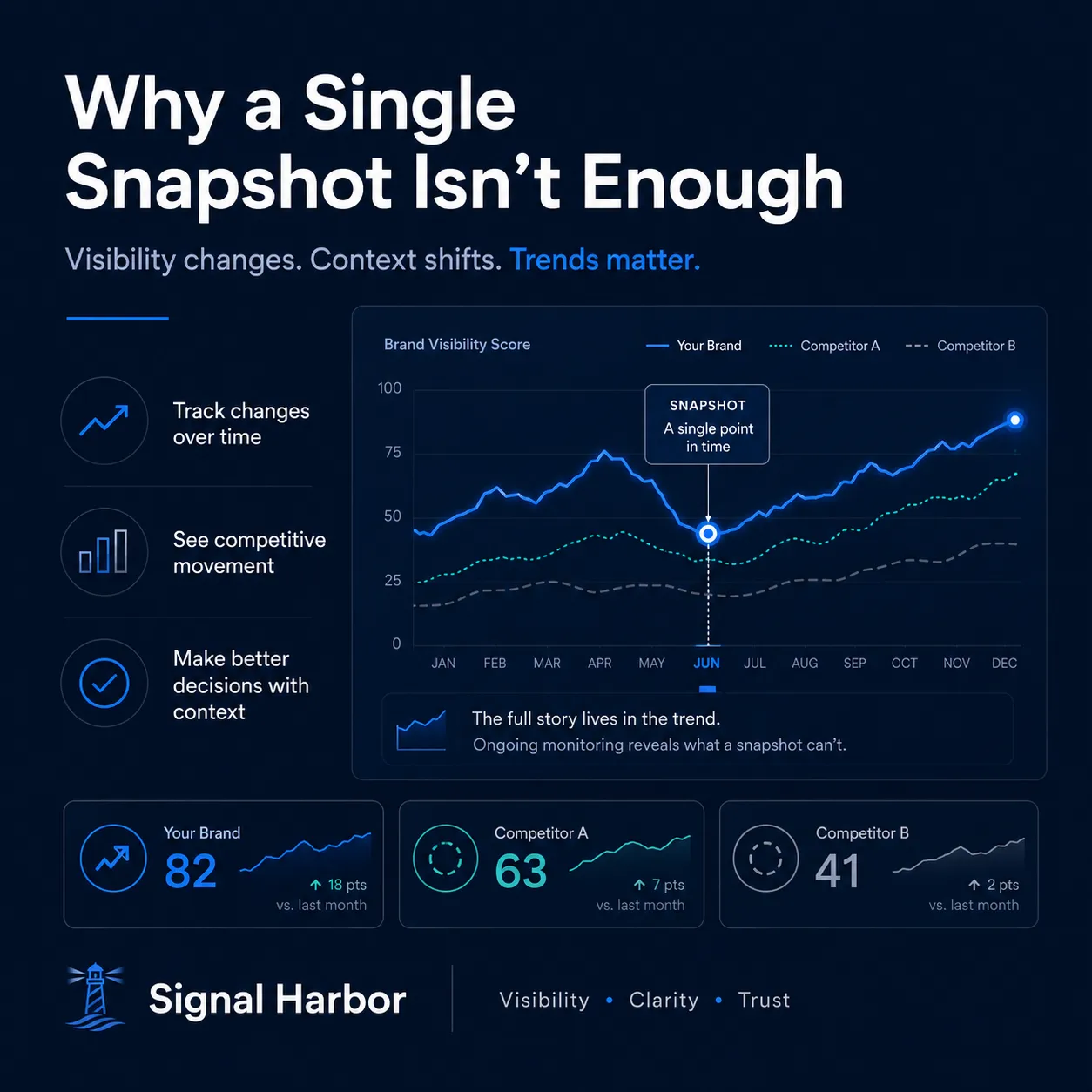
AI answers are not fixed search results.
Recent research from the University of St. Gallen found that AI search visibility varies across runs, prompts, and time, making one-off observations unreliable.
So a single ChatGPT, Perplexity, or Gemini screenshot is not a strategy.
It is one observation.
And one observation can be misleading.
The Real Question: Did AI Actually Understand You?
For B2B companies, showing up is only the first step.
You do not just want to appear in a citation list.
You want AI systems to understand:
What your company does
Who you serve
Where you are differentiated
Why a buyer should consider you
How you compare against competitors
Recent research on “citation absorption” shows that citation count alone is an incomplete metric.
Some AI engines cite more sources but absorb less from each one. Others cite fewer sources but rely more heavily on the sources they select.
That is the difference between surface-level visibility and real narrative influence.
The Blind Spot: Earned Media
Many companies assume AI visibility can be fixed by rewriting their own website.
That is only part of the picture.
A 2025 generative search study found that AI search engines show a systematic bias toward earned media: third-party, authoritative sources over brand-owned and social content.
That means your website matters.
But so do:
Review sites
Industry blogs
News articles
Comparison pages
Partner mentions
Directory listings
Third-party authority sources
If those sources describe your company poorly, incompletely, or less clearly than your competitors, AI may repeat that weakness back to buyers.
In AI search, your brand is not only what you say about yourself.
It is what the broader web says about you.
The Move: Measure Repeatedly, Not Casually
McKinsey & Company reports that 50% of consumers already use AI-powered search today, placing 20% to 50% of traditional search traffic at risk.
So the answer is not to ignore AI visibility.
But it is also not to trust one-off screenshots.
At Signal Harbor, we believe:
A single response is an observation.
Repeated measurement creates intelligence.
Our diagnostic process is built to measure how companies appear across AI platforms over time, including ChatGPT, Gemini, Claude, Perplexity, Grok, and Copilot.
We look at:
Which brands are recommended
Which sources are cited
How competitors are described
Whether AI understands the company accurately
Which third-party sources appear to shape the answer
Where the brand is visible, invisible, or misrepresented
The goal is not to chase screenshots.
The goal is to understand how the AI ecosystem actually evaluates your business.
What Brands Should Measure Instead
A serious AI visibility diagnostic should measure more than whether a brand appeared once.
It should evaluate:
1. Presence
Does the company appear when buyers ask relevant questions?
2. Accuracy
Is the company described correctly?
3. Differentiation
Does AI understand why the company is different?
4. Competitor Positioning
Are competitors being recommended more often or described more clearly?
5. Source Influence
Which third-party sources appear to shape the answer?
6. Change Over Time
Do results shift across prompts, platforms, and repeated runs?
The Takeaway
AI visibility is becoming too important to measure casually.
If buyers are using AI systems to research categories, compare vendors, and build shortlists, companies need more than a vanity leaderboard.
They need a repeatable way to measure:
Presence
Accuracy
Differentiation
Competitor positioning
Source influence
Because in AI search, showing up is only the first step.
Being understood is what actually matters.
Want to see how the AI ecosystem evaluates your business?
Sebastian Miller
Co-Founder, Signal Harbor
signalharborconsulting.com
sebastian.miller@signalharborconsulting.com
402-306-2213
Sources & Research Notes
Schulte, J., Bleeker, M., & Kaufmann, P. (2026). Don’t Measure Once: Measuring Visibility in AI Search (GEO). University of St. Gallen / arXiv.
Zhang, K., He, X., & Yao, J. (2026). From Citation Selection to Citation Absorption: A Measurement Framework for Generative Engine Optimization Across AI Search Platforms. arXiv.
Chen, M., Wang, X., Chen, K., & Koudas, N. (2025). Generative Engine Optimization: How to Dominate AI Search. University of Toronto / arXiv.
McKinsey & Company. (2025). New front door to the internet: Winning in the age of AI search.
This article first appeared in Signal Harbor Weekly, the Signal Harbor newsletter on AI visibility.